Tuesday, February 15, 2011

HALFWAY!

Congratulations, all you YAVs around the world, we've made it to the halfway point. I wouldn't say that the time has flown by, nor has it dragged on. When I think of September, it seems like yesterday and a lifetime ago at the same time. So much has been packed into the last five and a half months, that I can't even predict what will be come to pass over the next five and a half.

I feel that at this point, I should probably do some deep reflection and have something valuable to say about how I have spent the last half year. However, we all know this isn't my style. And really, I love to instead focus on the moment and the joys and adventures that are happening everyday. Besides, my last post was semi-serious. So, instead of trying to drop some pearls of wisdom or carefully sculpted reflections, I'm just going to show you a few fun things that have been happening in the past few weeks.

BOMUNSAN
This is a mountain in Daejeon. I went here during Sollal, the Lunar New Year Celebration. It was nice hiking around the icy heights, taking in the pretty views, and chatting up the old men.

EXPO PARK SOLLAL CELEBRATION FOR FOREIGNERS
Expo Park is one of the most popular sites in Daejeon, as it houses tons of museums and an amusement park. During the Lunar New Year celebration, it hosted a festival for "global friends," that was complete with silly contests, prize drawings, playing of traditional Korean games, and eating tteokgu, the rice cake soup that must be eaten often during Sollal.
I loved this ride that was kiwi-themed.
Playing the world's largest dragon drum. BOOM!

DR. FISH
Are you feet feeling a little callous-y? Have a little dead skin that you wouldn't mind parting with? Then Dr. Fish is the place for you! Stick your feet into the warm water. Feel a little tickle. Look down, yes, those are swarms of fish eating the dead skin off of your feet. Visited this gem with Katie, Kristen and the Khim kids. Munch munch.


ROCK ON!!!!!!!!!!!!!!!!!!!!!
Over the weekend we transformed our house into a full-blown rock concert, replete with guitar hero, wii dancing games, several craft stations, a photo shoot, American food, and cupcakes filled with Reese cups. Not to mention a dozen 9 year-old rock stars with names like Dude, P, Roxy, and Sparkle. This was Kai-Li Khim's birthday party. Although who had more fun, me or her, is a matter of debate.
You might think this is Avril Lavigne, but it's really me.
My fellow rockers, Luka and Kai-Li Khim.

Other recent highlights:
--a huge duck lunch with the Japan group. Multiple courses of duck. Delicious. Thanks Rev. Choi!
--Taekwondo on Mondays. Hiya!
--meeting Katie's parents and joining them at Outback Steakhouse for our halfway point celebration!
--hanging out with my awesome kids from Seomna Center and teaching them the Miss Mary Mack hand clap game (which was a huge mistake, as I have now done it close to a million times)

Monday, February 7, 2011

Being cared for by strangers

In the past few weeks I have been more amazed than usual at the incredible generosity and hospitality of strangers around me. Others, including Simon and Becky, have talked about the hospitality that we received in Japan, so I won't dwell on that here. But, yes, in Japan we were remarkably well cared for by strangers who welcomed us with open arms.

Instead, two recent incidents stand out to me.

This past week was Lunar New Year, the most important holiday in Korea, so I did not have work for the week. Instead, I did some exploring around my city of Daejeon. One day I was up hiking at Bomunsan Mountain, where I was repeatedly stopped by people asking if I needed directions or just looking for a chat--a chance to practice their English and to greet an American. On my way to the trail head, when I wasn't quite sure where I was going, a man led me until he got to his turnoff point, then passed me off to two older women who walked with me until they got tired and passed me off to a man who was heading my way. Even though I could have eventually found my way on my own, these wonderful people instead walked with me and guided me. Strangers took my picture when I asked them to; one man even gave me a lift back to the train station after my hike.

Each week I visit foreign migrant men at their places of residence. Their accommodations are usually much more humble than mine, and these men are, undoubtedly hard workers. Instead of resenting me my privileged, undeserved, position, these men (and sometimes women) are glad to see me and so welcoming. I am always given drinks or snacks. Last week I sat down to a very full meal of grilled seafood lettuce wraps with a big group of men from Vietnam. This Sunday I shared delicious food with four men from Indonesia. I shouldn't be eating their food, but they seem genuinely happy to share and eat together.

I am continually humbled by the friendliness, graciousness, and generosity of strangers around me. These people teach me much. I hope that someday I can be as welcoming and open hearted.

Saturday, February 5, 2011

A Sojourn in Japan: Part 3

Just a few random things that I thought were interesting:

1. There were bikes everywhere in Japan! Much more than in Korea or the US, bikes were a major and common form of transportation. However, as we found out, the fad of biking is less about the environment or exercise, and more about the inaccessible price of cars.

2. Photo booths seem to be quite popular! On two separate occasions we were taken to photo booths to do crazy poses, decorate them, and print them off. If you go to malls or arcades, there are scores of these photo booths.

3. In Japan, girls can be in the boy scouts.

4. In both Korea and Japan, Valentine's Day is when girls give gifts to boys. White Day (in March) is when boys give gifts to girls. Black Day (in April) is a day for singles, who wear black and eat black food. I plan on celebrating all three.

5. Animation is very popular in Japan!

6. Universities all seem to have middle and high schools associated with them.

7. In some cities, the cable car is still a regular form of transportation.

8. American football is played at Japanese universities! Who knew? Kwansei Gakuin's team is apparently very good.

9. When we were riding with our host family in Hiroshima, the girls started singing "Country Roads." I was amazed that John Denver would have made it across the generation and geographical distance, but we all sang a rousing rendition of the song as we traveled the hills in rural Japan. However, the girls then played this song for us, which gave me a very different understanding of how they came to know the words to the J.D. classic. Turns out they hadn't heard of John Denver, but a Japanese artist had used the same words in this totally tech-no (but funny!) "Country Roads" song. Sigh.


(Turn your volume way up for this, the sound is a little low. And don't worry about viewing the video, there's nothing to see. Focus on the music.)

Tuesday, February 1, 2011

A Sojourn in Japan: Part 2

FOOD!
Japan has a very proud cuisine tradition. I was more than happy to let them show it off to me! Here are some of the things that I sampled during our brief stay.

This is donkatsu. It is breaded, fried pork that the Koreans have also adopted. It is very prevalent in Japan, though there are several varieties. This version is served over an omelet sort of thing with sauce.


Donkatsu: this version has unique ingredients, including asparagus! First time I have had asparagus since leaving the States. Sad, I know. Though different from the pork variety, this is still breaded and fried, served with many side dishes including shredded cabbage salad and a sauce that you made by crushing pepper with your own mortar and pestle.

This is takoyaki--octopus balls! A piece of octopus is battered and cooked, so it ends up being sort of like a pancake with a morsel of octopus inside. Actually, the insides are a little gooey. This version is served with stir-fried noodles and ginger. It is most famous in Osaka, and is a common street food. Really, it's a must-try.
Sara udon is a dish that is native to Nagasaki. It is thin, crispy fried noodles topped with seafood, cabbage, and other vegetables. At first it felt like eating uncooked Ramen noodles, but they were actually very flavorful and the dish was quite delicious, albeit unusual texturally.
We were treated to a very elegant meal at Kwansei Gakuin Univeristy. This salad course was my favorite, as it consisted of smoked salmon, roe, scallops, and balsamic vinegar. They served us many other delicious courses, but I would have been content with 3 more plates of this.
Ramen noodles are very popular in both Korea and Japan. The Korean version is mainly broth and noodles, and it is very spicy! This Japanese version has many vegetables, like peapods, onions, and mushrooms, and is in a savory, not spicy broth. It was wonderful! I got this and the sara udon at college dining halls. If only American dining halls had such dishes!


This pile of goop is called okonomiyaki, and it is famous around the Hiroshima area. I ate this on the island of Miyajima off the Hiroshima coast. This one is noodles, seafood, cabbage, etc sandwiched between some pancake type things and topped with sauce. It is tastier than you might think! MMMmmm...
One night, Simon treated us to a very fancy, six-course Japanese restaurant. The star of the meal was the crab, which was served in multiple ways. Above and below are two of the most delicious dishes. The first is a seafood hot pot with veggies and mushrooms. It boiled right in front of us over an open flame. The second is glutinous rice on a giant leaf topped with crab, fish and a smattering of other things. You think eating crab with a fork is tricky? Try metal chopsticks.

Katie and I ate this at a place in Osaka. It is rice topped with beef, tofu and a few noodles, served with green tea. It was extremely fast and extremely inexpensive, and was served in a diner-like setting. Basically, this seems like Japanese fast-food. Sign me up!
Did you know Japan is big on curry? I didn't. But after experience Japanese curry (multiple times), I understand why! Talk about satisfying. This big bowl is udon noodles and a bit of beef and onions, in curry sauce topped with tempura shrimp. I am hooked.

And what trip to Japan could be complete without sushi? I had a few different kinds of sushi when I was there, including a few different bento boxes. This one was served to us at Yodogawa Christian Hospital. The variety of fish was pretty cool, and the two-tiered box allowed for a whole serving of rice too, all in a neat little package. Pretty nifty.


Finally, no, this man is not food, but he does eat a lot of food. A lot. Katie and I were in dotonbori in Osaka when we saw a crowd around this guy, all getting their photos with him. So, I jumped into the fray to get a quick snap. When I was standing next to him, I asked him why everyone was posing with him, and he seemed quite taken aback that I didn't know who he was. Yet, he assured me that he was famous, "number one." Well! After a little research and some help from Japanese friends, I discovered that he is a TV host who goes around eating GIANT portions of food! He is the Adam Richman (Man vs. Food) of Japan. He has won second place in Nathan's Famous Hot Dog Eating Contest. Even his nickname is awesome: Nobuyuki "The Giant" Shirota. Sir, I salute you.

Saturday, January 29, 2011

A Sojourn in Japan: Part 1

Konnichiwa! I have just returned from a 10 day visit to Japan and have much to share. I will probably tell about the adventure in multiple blog posts. This first will outline generally what happened. I went with my fellow YAVs (Katie and Becky), our site coordinators, 3 Korean college students, and a Korean college chaplain. This was a cross-cultural study trip. We visited three universities in Japan and had presentations on environment, peace, and discrimination. I spoke in Hiroshima about peace.

Our home base was Kobe. But, from there we took the public transportation, including the super sweet bullet train, all over southern Japan.


In Nagasaki, we saw many temples and shrines, but the highlight was the Atomic Bomb Museum and the Peace Memorial Park. I can't begin to describe or understand the horrors that Nagasaki experienced, but atomic bombs should never, ever again be used.
This monument marks the hypocenter of the explosion, where the bomb detonated 500 m in the air. Around 70,000 people died in a matter of moments, with thousands of more deaths in the next months and years related to the bombing.

But rather than responding with more violence, both Hiroshima and Nagasaki have become international leaders in the peace movement to rid the world of nuclear weapons. This is a statue in the Peace Memorial Park in Nagasaki.
We also explored the city of Kyoto, a city rich in history as it was the imperial capital of Japan for centuries before the capital was moved to Tokyo.
Here is a beautiful pagoda at Kiyomizu shrine.
And this gem is the breathtaking Kinkakuji pavilion at a Buddhist temple.

Also in Kyoto we saw the walls of the imperial palace, the imposing Nijo castle (one-time home of the Shogun), Nishiki traditional market, and other temples and shrines.

In Osaka, the highlight was seeing Osaka Castle.
It really is stunning.
At the Osaka History Museum, Katie and I got to be dressed in Japanese kimonos.

I spent a day in Tokyo. One of the great parts of the day trip was getting to meet up with Dr. Nordmann, a professor from Coe, and his wife Stephanie who took me around Tokyo where they are living for the year.

This is Sensoji temple, where these lanterns were pretty amazing.
Meiji shrine is one of the top places to see in Tokyo, and it is a very tranquil, historically rich place.
This is the Akihabara district, which is known internationally for electronics and technology.
This building under construction will be known as the Tokyo Sky Tree or the New Tokyo Tower. When completed it will be the tallest tower in the world.
Finally, we went to Hiroshima, which you can imagine, was interesting and challenging. It was fun to see sites that are famous, but the fact remains that they are recognizable because of horrible tragedies. This was the A-bomb dome. We went to the museum, which was well done and devastating, and the peace park is beautiful. However, it makes you pause when you realize you are walking on ground that is elevated several feet from where it was before the bomb. This is because there was so much debris and so many bodies that they couldn't all be removed, so dirt was just brought in and covered over the area to make a new ground level. Again, atomic bombs should never, ever again be used.

Finally, we went to Miyajima, which is an island off the coast of Hiroshima. This area is a UNESCO World Heritage Site and one of the top three most beautiful places in Japan. The most recognizable feature is this gate in the water, but the island is quaint; it is covered in majestic mountains among which are nestled temples, shrines, and little shops. It was a nice way to end our travels.

Stay tuned, I think the next Japanese blog post will be about the food!

Saturday, January 8, 2011

The holidays and Brandon's visit.

As you can imagine, one of the hardest things about being abroad is missing the yearly traditions of friends and family, the sorts of things you look forward to all year, every year. The Christmas and New Year's holidays here could have been really tough. We didn't have much going on for either holiday--no tree, only paper stockings, very sparse gifts mailed from overseas, and nary a Christmas light to be found. New Year's was even less of a celebration, as it is the lunar New Year (in February) that is heartily celebrated.

Fear not, though, the holidays turned out not to be a gloomy affair after all, because of one huge factor: Brandon came to visit! I had not seen my boyfriend for four months, so this was a very very welcome treat. He stayed for three weeks, and we had a wonderful time. In just this short time, he traveled up and down the peninsula, met dozens of people, and very impressively sampled an astonishing array of Korean foods...some that I had not even tried (nor did I want to, like chicken feet and pig's feet.)

We did too many things to go into detail here, so I will just put up some photos that highlight Brandon's time in South Korea. Now all we have to do is make it another seven months before we see each other again...

Brandon had been dreaming about Korean dumplings for months, so on his first night in the country we ate these monstrous, delicious, meat-filled steamed dumplings.

We visited Gyeongbuk palace, the main palace from the 600-year Joseon dynasty, where Brandon got to dress up like a historical Korean gent. I think he looks dashing.

We got into the holiday spirit more when we found this outdoor ice skating rink in the heart of downtown Seoul.
Brandon helped me to celebrate my graduation from Korean language class. Do I still deserve to graduate even if I can't read what my diploma says?

We ate a not-so-traditional Christmas meal of dumplings, fried pork, and French fries.
This is us at Cheomsongdae, an ancient astronomical observatory, in Kyongju, the capital of the ancient Silla kingdom.
The most impressive part of Kyongju was seeing Bulguksa temple (pictured) and Seokguram grotto.
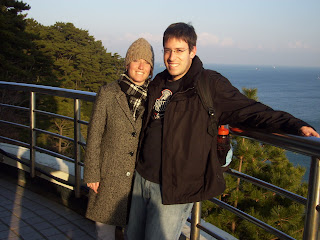
In Busan, we saw some awesome ocean views!
We also hiked around an ancient fortress.

Eventually we made our way back to Seoul, and saw some interesting sights, including National Treasure No. 2, this ancient pagoda.
And we enjoyed a bit more Korea cuisine.

All in all, we had an amazing experience. It was great for Brandon and I to be able to enjoy each other's company, and having shared this time together will help us to get through the next seven months apart. We were able to take in so much of the Korean culture and take in a lot of sightseeing that I don't get to do here normally. So, thanks, Brandon for an awesome trip. Go Korea!

Monday, December 13, 2010

Seomna Center

The countdown is on...only 5 days until Brandon gets here. So, I want to make sure I get this blog in before his visit and we begin our travels around Korea. This post is very important to me and my life here. It's something I've been wanting to share for a while.

I work 5 days a week at a place called Seomna Center. Recently, the pastor Rev. Kim and his wife were gracious enough to take the time to tell me about their center and the work that they do. It is inspiring, life-changing work, and I am honored to be a part of this community.

Seomna Center is actually just one part of Bindl Church. Seomna Center (or Seomna House) focuses on work with children, the elderly, and the local community. The Center is located in Taehwadong, which is a very impoverished area, so there is much need here that Seomna is working hard to meet. With the children, I have fellowship with them (playing, eating, supporting) and teach them English. As of yet, I have not done much work with the elderly or community outreach, but I hope to learn more about it next semester. Another branch of Bindl Church focuses on peace workers, migrant workers, women (foreigners) and multicultural families, which is a big issue of discrimination here. The final branch focuses on environment and well-being. I do some work with the foreign laborers (visiting their places of residence and employment) and the foreign women (I do an arts and crafts class with them and teach them English). Last week I was fortunate enough to attend an end-of-the-year celebration for one of the environmental organizations. However, I also hope to learn much more about these branches of the Bindl Church.

The organization has an impressive history. It started in the mid-1980s as a people's church--one that recognizes a community of all people. The poor are prioritized instead of ostracized. Rev. Kim wrote that a people's church "should make community with all beyond class, gender, age, social position, even race and religion, and must work with and for minjung (translated into the masses/poor people) in any situation." We should not meet foreigners or the poor to evangelize to them, but we should greet them as brothers and sisters. What a wonderful philosophy.

To this end, the organization works for the improvement of human rights and working conditions for foreign migrant workers, including advocating/lobbying for changing laws and institutions. They were instrumental in establishing some of Korea's first labor unions. Also, they help in situations of unemployment (even allowing temporarily unemployed people to live in the center), provide support for living necessities (like internet, remittances, cell phones), provide medical services, put on special social activities for an otherwise isolated community (like birthday parties, picnics, cultural events, English and Korean study), operate a migrants' library, provide counseling, build networks in home countries, and support migrants who wish to attend college through scholarships.

Seomna Center, as a part of Bindl Church, was one of the first centers to provide after-school care to kids, and the very first to provide a free feeding children. Back in the 1980s, Seomna was unique, but it's model has caught on, and now there are over 3,600 children's centers in Korea. Still, Seomna leads the pack. In 2009 the government did an assessment of all the children's centers, and Seomna came out as the best. Through this attention and coverage in documentaries and TV broadcasts, Seomna is well-known and emulated. The children at the center not only get top-notch English education ;), but can take part in a nationally-acclaimed drum group that is invited to perform all-over the country, engage in art and music therapy, learn gardening, swimming, cooking and all sorts of other skills, and have a lot of fun on regular outings. So far with them I have gone mountain climbing and attended a show at the symphony hall. The children are all impoverished--in order to apply, families have to submit their financial information. Yet, they are some of the most patient, kind-hearted, loving children I know. I adore them.

Other parts of the church's many programs include providing help for families dealing with alcoholism, networking with schools/NGOs/hospitals/other institutions, reaching out to homeless families, lobbying the government for more pro-poor policies, feeding/visiting the poor and elderly, and I am sure many other activities that I do not yet know about.

Next term, in February, I will not be taking language classes at Hannam, so I am eager to be more engaged at Bindl Church. I want to learn much more about their wonderful work, and do what I can to support their vision of, according to Rev. Kim, a Global Community Movement based on people, especially returning migrants.

This picture is of (clockwise) me, Simon, Haejung, Rev. Kim, Mrs. Kim, and So Young Teacher, who is absolutely wonderful and my main contact at the children's center.